
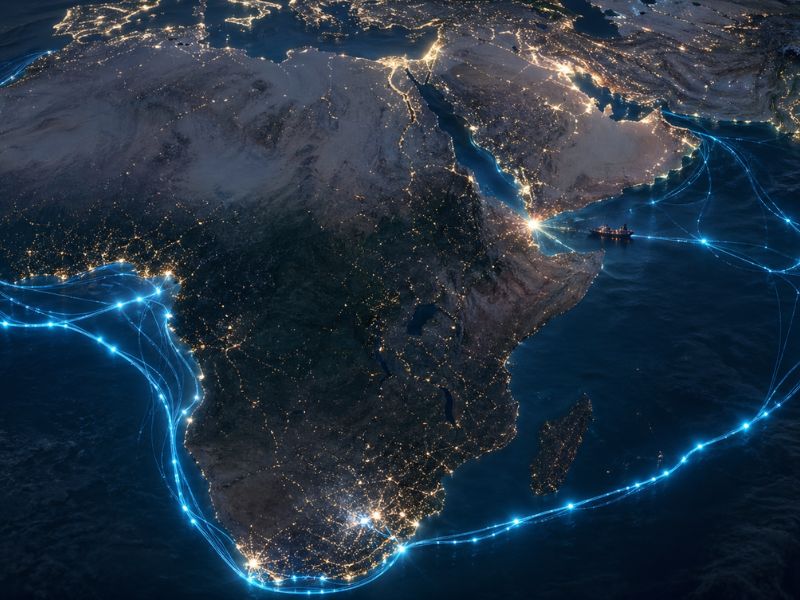
In an era where digital connectivity is the backbone of business, the physical security of the internet is often overlooked. For South African businesses and residents, the distance from the Middle East might suggest immunity to regional instability. However, recent geopolitical events in the Red Sea and Persian Gulf have proven otherwise. As a premier provider of web hosting and digital solutions, Rhino Hosting is committed to keeping you informed on why your “local” connection is deeply tied to global events.
The Undersea Chokepoints of Global Data
Approximately 95% of international data is transmitted through a vast network of undersea fiber-optic cables. The Middle East serves as one of the world’s most critical digital transit hubs. Specifically, the Red Sea is a narrow corridor through which 17% of all global internet traffic passes, connecting Europe to Asia and Africa. Recent escalations in the Middle East have placed this infrastructure at risk. In early 2024 and again in 2025, several major cable systems – including the South East Asia-Middle East-Western Europe 4 (SMW4) and the 2Africa network – suffered disruptions. While some damage was caused by kinetic military action, much of it resulted from the “fog of war,” such as commercial vessels in distress dragging anchors across cable beds.
How This Affects South African Connectivity
South Africa relies heavily on a few primary undersea arteries. When cables in the Red Sea or the Gulf of Aden are damaged, the impact is felt locally in three distinct ways:
- Increased Latency: When a direct path through the Red Sea is severed, data must be rerouted. Often, this means traffic is sent around the west coast of Africa or even through the Atlantic and across the United States. This longer physical journey results in higher “ping” or latency, affecting everything from video conferencing to online gaming.
- Reduced Redundancy: South Africa has significantly improved its connectivity with cables like Equiano and WACS on the West Coast. However, many enterprise services and cloud providers still rely on the “East Coast” routes via the Middle East for balance. If one side of the continent’s connection is compromised, the remaining cables become congested, leading to slower speeds during peak hours.
- Infrastructure Delays: Significant projects like the 2Africa cable – the world’s largest subsea system – have faced delays in their Middle Eastern segments (such as the “Pearls” section) due to regional instability. This delays the arrival of increased bandwidth and lower costs for the South African market.
Protecting Your Business in an Uncertain Digital Climate
While we cannot control global geopolitics, we can control how our digital assets are managed. At Rhino Hosting, we focus on providing robust, localized solutions that mitigate the impact of international cable failures.
Local Hosting Matters: By hosting your website on South African servers, you ensure that local visitors do not have to wait for data to travel across broken international links just to view your homepage.
Content Delivery Networks (CDNs): Utilizing a CDN allows your website content to be stored in multiple locations worldwide, ensuring that if one route is blocked, your data finds the next fastest path to the user.
Reliable Support: Having a hosting partner that understands the local landscape means you get accurate updates when global outages occur, rather than being left in the dark by international providers.
The “digital silk road” through the Middle East remains a vulnerable point for the global internet. For South African businesses, the strategy is simple: hope for global stability, but build for local resilience.
Rhino Hosting – Reliable. Local. Secure.
Looking for hosting that stays fast, even when the world gets complicated? Explore our South African hosting packages today